If you are just starting out in woodworking, the tool aisle can feel like the hardest part. There is a lot of stuff out there, and plenty of people happy to tell you that you need all of it. You don’t. This is the first post in my tools series, and it covers the handful of things I think are worth getting first.
Two ideas sit behind everything below. First, buy once and buy right: a decent tool that does its job will serve you far longer than a cheap one you end up replacing. Second, buy tools as your projects need them. Let the work tell you what to get next, rather than filling a toolbox with things that never leave it.
Measuring and marking
Most mistakes in woodworking start before a single cut is made. A reliable tape measure, a steel rule and a combination square will cover almost everything at the start. The square lets you check that edges are square, mark lines across a board and set depths. Add a sharp pencil, and later a marking knife, which leaves a fine line your saw or chisel can register in. Measure twice, mark clearly, and use the same tape for the whole project.
A good hand saw
One good saw will take you a long way. A general-purpose saw that cuts cleanly across and along the grain is a sensible first choice, and many beginners find a pull-style saw easy to control. Whatever you choose, keep it sharp and let the saw do the work. If you have to force it, something is wrong.
Chisels
You don’t need a big set. Three or four bench chisels in common widths will handle most joinery and clean-up work. More important than the number is that they hold an edge and that you keep them sharp. A blunt chisel is harder to control and more likely to slip.
A block plane
A small block plane is one of the most useful tools you can own. It fits in one hand and is great for easing sharp edges, trimming end grain, fitting parts and taking off that last bit that stops something from closing. Learn to set it for a fine cut and you will reach for it all the time.
Clamps
There is an old saying that you can never have too many clamps, but you don’t need them all on day one. Start with a few that suit the size of what you are building, and add more as projects ask for them. Clamps hold work while you cut, act as a second pair of hands, and are essential for glue-ups.
A drill/driver
If you buy one power tool first, a cordless drill/driver is a good bet. It drills holes and drives screws, and you will use it on almost every project, in the shop and around the house. A clutch, so you don’t overdrive screws, and a decent set of drill bits matter more than raw power. More on power tools, and cordless versus corded, later in the series.
Sharpening
This is the one people skip, and it is the one that makes the biggest difference. Sharp tools are safer, more accurate and far more enjoyable to use. You need a way to flatten and hone an edge, whether that is sharpening stones, diamond plates or abrasive paper on a flat surface. Pick one system, learn it, and stick with it for a while before trying another.
Safety gear
Not exciting, but not optional. Get safety glasses, hearing protection and a proper dust mask from the start. Fine wood dust is bad for your lungs, and hearing damage does not come back. Keep a basic first aid kit nearby too. None of it costs much compared to what it protects.
A place to keep it all
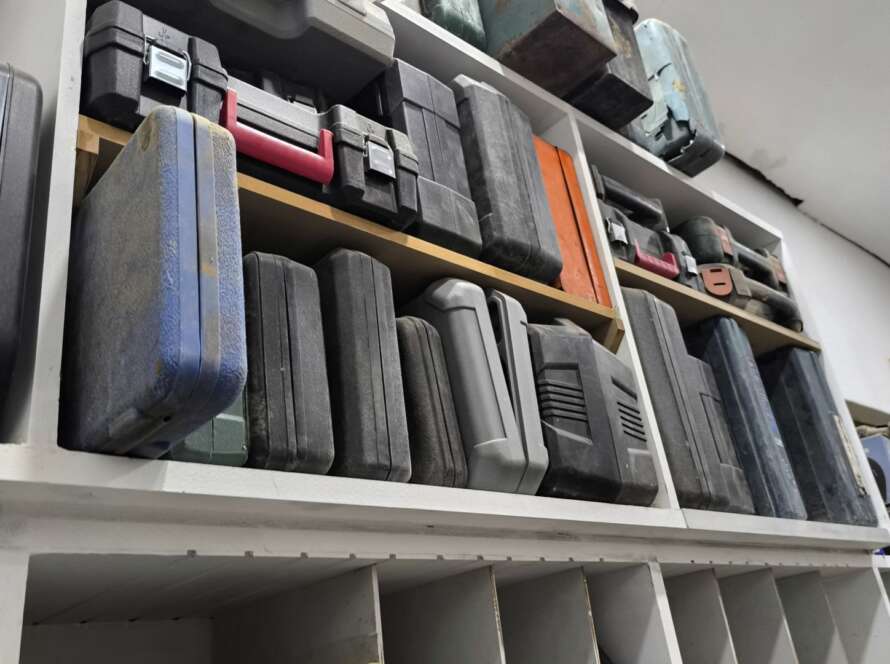
A toolbox or a simple wall rack keeps tools protected and easy to find. Edges stay sharper when they are not rattling against each other, and you waste less time looking for things. It doesn’t need to be fancy. Building your own tool storage is also a good early project.
Start small
That is a starter kit that will let you build real things. Pick a simple project, use what you have, and notice what you keep wishing you had. That is the tool to buy next. Skills grow faster than toolboxes, and that is the way it should be.
Next in the series: Part 1: Choosing a toolbox: what size is right. You can follow the whole series on the Tools Series page.